


You Stay Calm. Your Anger Waits Its Turn.
3 min read
The conversation just ended. While it was happening, you stayed calm. You explained, you reassured, maybe you even downplayed what you were feeling so things wouldn't escalate.
Then you're alone. Your jaw is tight. You replay what was said — and especially everything you didn't say. The responses come now, all at once, too late to do anything with.
You're angry. Not just at the other person. At yourself too, because once again you didn't let on what was really happening inside you.
If this happens to you often, it's not because you lack courage. It's because your nervous system learned, a long time ago, to protect the relationship before protecting your truth.
Anger That Waits Until It's Safe
We often think that real anger should come out in the moment. But your nervous system doesn't work like a switch.
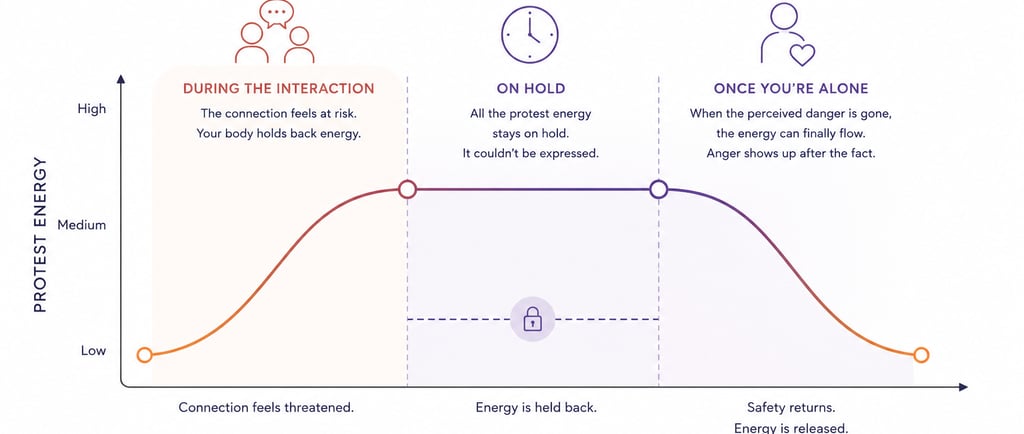
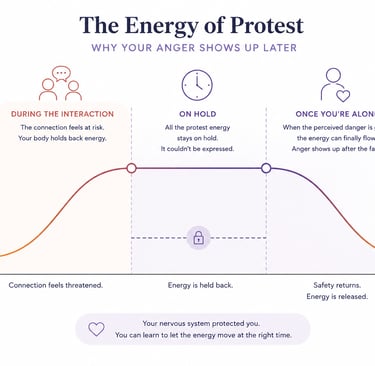
During an interaction that threatens the relationship, your body prioritizes one thing above all: staying relationally safe. All the energy that could have gone toward setting a limit, saying no, or showing your disagreement stays on hold. It's only once you're alone, once the perceived danger has passed, that this energy can finally move. That's why the anger shows up afterward — often alone in your car, in the shower, or right before falling asleep.
This anger isn't a character flaw. It's a protest that couldn't happen at the right moment — and it surfaces once your body finally judges it safe.
The Child's Dilemma: Learning Not to Protest
Why does your system wait so long before letting you feel this?
For a child, protesting against a parent — even gently — can feel like it puts the relationship at risk. And because that relationship is a matter of survival, the child learns quickly: better to swallow the anger than risk losing the attachment. It's not a conscious choice. It's an adaptation, repeated until it becomes automatic.
Years later, the same reflex activates in front of a partner, a boss, a friend. You stay composed while the other person talks. And your anger keeps waiting its turn — exactly the way it learned to.
What Your Anger Is Trying to Protect
This after-the-fact anger isn't just looking for a way out. It often carries a simple message: that wasn't okay. My limit wasn't respected. I didn't want to say yes. I needed to be heard.
This energy that says no, that protects a limit or defends a need — that's what we can call healthy aggression. It also lets you feel more clearly: here's what I want, here's what I don't want, and here's where I stop.
And feeling this energy doesn't mean yelling, hitting, or losing control. You might feel heat rising in your face or neck, your jaw or fists tightening, a slight trembling, your heart speeding up — without having to do anything against the other person. Feeling is not the same as acting.
The Cost: Anger Turned Against Yourself
The problem isn't that the anger exists. It's that, with nowhere to go in the moment, it often turns back against you. It becomes self-criticism — you're angry at yourself for once again saying nothing. Over time, this can leave a particular kind of tiredness: the tiredness of always holding something back, then replaying the conversation in your head long after it's over.
Reading What's Happening Now, in the Body
The next time this after-the-fact anger shows up, you don't need to understand why right away. You can simply notice where it lives — the jaw, the chest, hands closing. Stay with it one second longer than usual, before putting it away or turning it against yourself.
And if one day you manage to name to the other person what actually happened for you, it can be as simple as: "When you said that, I notice my jaw tightening. I feel angry. I have the thought that I didn't manage to tell you my limit." Not an accusation — just what was there.
This kind of sharing assumes it's actually possible to speak without putting yourself in danger. In a situation of violence or threat, staying safe remains the priority.
You no longer have to wait until you're alone for what's happening inside you to exist in the relationship.
Do You Recognize Yourself in This?
The goal isn't to become harder, or to let anger make decisions for you. It's to reclaim enough access to this energy to be able to stand your ground, while staying in connection.
Relational and Somatic Therapist
Online sessions · Montreal, Quebec
Email: contact@francoislacharite.com
Navigation
Resources
Approach
Couples Therapy
About
FAQ
Getting Started
Testimonials
Contact
Book My Free Call
Professional Framework
Member of the International Compliance Assurance for Holistic Practitioners (ICAHP)
Member of the Association des Naturothérapeutes du Québec (ANQ)
© 2026 François Lacharité. All rights reserved.